
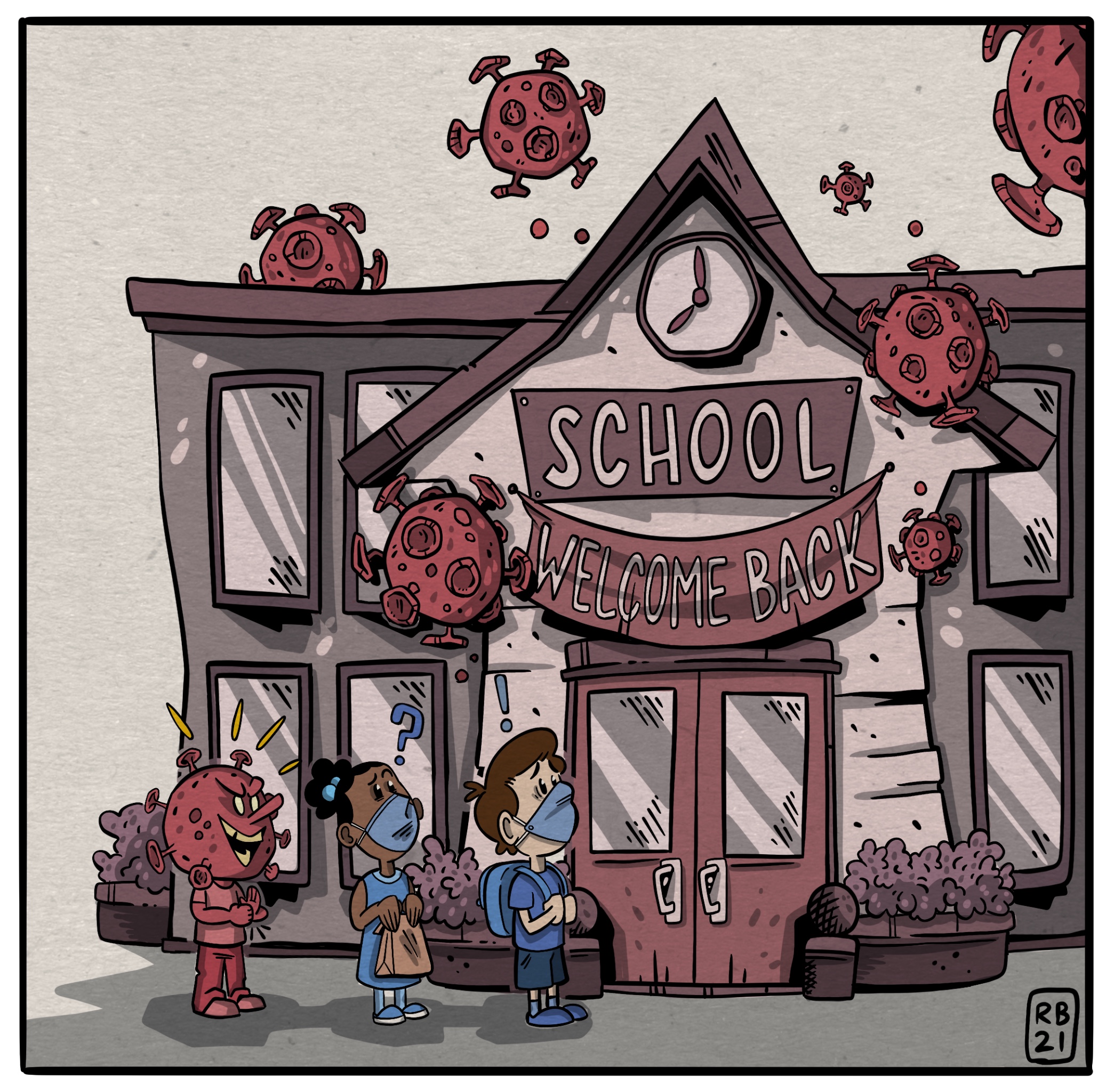
“Welcome Back, Covid!” Comic by Reilly Branson, reillybranson.com, Instagram: @rad_reilly. By permission.
The debate over safe school reopening is far from settled a month after the Center for Disease Control released its guidance. The guidance is clear enough, but sets standards so high that few schools can meet them for a full return to in-class teaching.
The push for reopening goes on anyway, with local authorities and school boards saying the classrooms are safe, and too many parents and teachers mistrusting them. The story is multifaceted and complex, because the pandemic has laid bare deep problems with schools, just as with so many other of our institutions. In this article, I’ll look at how difficulty meeting the CDC standards shows the need to address long-standing failures of public education, an abiding crisis which has deep structural roots. The American Recovery Plan Act allocates $122.8 billion for elementary and secondary schools, but the list of needed resources is long, and it will take more than money to transform a culture content to perpetuate racism and inequality.
First, the CDC Guidance and the difficulty of safe reopening. The CDC warns that safety depends on crucial “mitigation measures.” Masking and physical distancing are the most important, along with hand washing, cleaning, and ventilation. Ensuring that students wear masks correctly might be hard enough. (CDC Director Rochelle Walensky said that only 60% of schoolchildren are “reliably masking.”) But teachers are also thinking about how to have physical distancing in overcrowded classes, hand washing when there are no sinks in the classrooms and no soap or hot water in the lavs, filthy classrooms with privatized and unaccountable janitorial staff, and ventilation in 100-year old buildings. Surveys in a number of cities show parents, who also know the state of the buildings, don’t trust the schools to keep their children safe.
Can schools be safe when the community isn’t?
Hard enough to meet these safety guidelines, but there’s one even more difficult and controversial: the community transmission level. The level in the schools is associated with the level in the community, and the CDC “underscores the importance of controlling disease spread in the community to protect teachers, staff, and students in schools.” Yet cities are removing restrictions on masks, distancing and in-door dining just when they’re reopening the schools.
When the CDC issued its guidance Feb. 12, almost 99% of children lived in “red zones,” with the highest level of Covid-19 transmission.* The guidance says that teaching in red zone schools should be remote for middle and high schools, hybrid for elementary schools, unless they can “strictly implement all mitigation strategies” — and that means “physical distancing of 6 feet or more required.” Schools in the orange zone should operate in hybrid mode with 6 feet of physical distancing. That’s 6 feet, period. Not, as in blue or yellow zones, “6 feet or more to the greatest extent possible.”
This guideline for distancing becomes a bit slippery, and many districts require only 3 feet.
“Covid Safety Lapses Abound”
It’s easy to find anecdotal reporting about the difficulties students and parents are having with the closures. But you need to look harder to find articles about the failure of schools to implement the CDC’s safety measures. Here is one, a summary of the Kaiser Health Network’s analysis of federal and state data: “‘We’re Not Controlling It in Our Schools’: Covid Safety Lapses Abound Across US.”
KHN reporter Laura Ungar described school districts whose safety guidelines left out the most obvious precautions — masking students and staff and quarantining them if they had close contact with someone who has the virus. “Employees reported sick children coming to school, maskless students and teachers less than 6 feet apart, and administrators minimizing the dangers of the virus and punishing teachers who spoke out.” [note: How serious are the safety lapses? There should be reliable statistics from the National Center for Education Statistics, but the agency is understaffed. “Biden seeks key school data to reopen schools — but the agency that collects it needs resources to do it.”]
“Punishing teachers who spoke out” may be widespread. If you follow teachers’ twitter feeds, you’ll see reports of threats and retaliation against teachers who reported unsafe conditions or spread news about sick students or staff. If you think this is widespread, then you should be skeptical about statistics on the safety of in-class learning.
But let me take a moment to restore your faith in government statistics. After New York Gov. Andrew Cuomo forced nursing homes to accept all hospital referrals, bringing an influx of Covid-19 patients, the virus spread exponentially, and nursing home deaths shot up. The optics here are not good, especially for the dead. Unsympathetic observers might even hold Cuomo personally responsible for the deaths. But this is where a trusted leader can teach us “Leadership Lessons from the COVID-19 Pandemic.” The Cuomo administration simply moved the dead from one column to another, counting the nursing home deaths as hospital deaths. No problem with the optics now.
This was lying from the top, but in many school districts we may have falsification not just from the top, but from up and down the chain of reporting.
Trust the science … “to the greatest extent possible”
It may seem unfair to throw any shade on the CDC. With Trump out of the way, it is giving crucial evidence-based leadership. But there are a number of areas where critics have said the CDC falls short and “seems to prioritize expediency over teachers’ health.” (To be fair, defenders of the guidelines could remind us that the CDC is balancing the harm to children from school closures.)
The most familiar guideline, after masking, is the 6 feet of physical distancing. Does “the science” say we should keep 6 feet of physical distance, or, as in lower-transmission blue or yellow zones, 6 feet “to the greatest extent possible”?
The relaxation of the 6 feet standard seems inconsistent with the CDC’s quarantine guidance. There the CDC says people need to quarantine if they have been in “close contact” with an infected person (who may have been asymptomatic). And “close contact” is “6 feet of an infected person for a cumulative total of 15 minutes or more over a 24-hour period.”
Note that time, also, is a factor in measuring spread. What if you’re sitting in a class room with an infected student or teacher for hours, not minutes? Is 6 feet enough distance then? And when classrooms have 30 or even 40 students, how can students sit 6 feet apart? CDC Director Rochelle Walensky explained, “We’re worried that people will not be able to get back to full in-person learning if we mandate six feet of physical distance.”
Can schools meet science-based ventilation standards?
More attention has been brought to scientists who criticized the CDC vagueness about ventilation, which Prof. Joseph Allen of Harvard’s Chan School of Public Health says is “buried in their new guidance.” The CDC had been slow to acknowledge the role of aerosols in transmission and the need to upgrade ventilation systems. Modernizing and upgrading ventilation is just too costly for school systems, and in-person teaching might not happen if “the science” dwells too long on aerosols.
This recent NY Times simulation, a brilliant interactive graphic, shows how the virus would spread in a poorly ventilated classroom, with virus loads increasing the longer the infected person shares space in the room. The visualization raises a tough question: Is 6 feet enough distance, given that teachers and students will be in that classroom not just for 15 minutes, but for hours? Given the danger from aerosols, is surveillance testing required, not just testing of symptomatic children and staff? No, that too would be costly.
Does “the science” say vaccination is not required for staff? The CDC does.
To my mind the most serious concession to expediency in the guidance has to do with vaccinations. When 90% of schools can’t adequately implement the safety measures, is it scientific guidance, or is it expedient science policy, to say that vaccination of staff is not necessary for a return to the classroom?
Added to all the safety concerns I mentioned, are worries about new variants of the coronavirus that causes Covid-19. Guidelines developed for the virus strains prevalent now may prove too weak as new more infectious or virulent strains spread. Will the vaccines work? Will the widespread refusal to wear masks and restrict activity in many parts of the country defeat efforts to control the pandemic? Can we really predict the risk level we will have in the fall, when schools nationwide hope to return to full classrooms?
Or is this the reason vaccinations are not “necessary”: The supply is limited, and waiting for the jab would have postponed reopening for another two or three months?
Teachers unions, where they are strong enough, insist on vaccination first; some also want the children vaccinated first. Some school districts are fine with waiting until teachers are inoculated — one Chicago suburb (Arlington-Heights centered Township School District 214) is returning April 5, 14 days after their teachers have had their second dose. They don’t consider teachers unreasonable for demanding that extra “layer of mitigation.” But, then, they aren’t an under-resourced, mainly Black and Latinx school district. (Less than 2% of the student population in District 214 is Black, less than 20% Hispanic. A 20-minute drive away, Chicago Public Schools, which is about 80% Black and Latinx, forced staff back without the vaccine and only agreed to organize shots for teachers in stages after the Chicago Teachers Union threatened to strike.)
And polls show that most parents think teachers should be vaccinated first. That is especially true of Black and brown parents, who are also keeping their children home at a much higher rate. In Chicago, only 29% of elementary and middle school students planned to return for in-person learning, and 1/3 of teachers received accommodations and are teaching remotely. In California, 65% of parents want remote-only learning.**
The Biden administration is making great efforts to speed up vaccination of teachers, with the goal of vaccinations, at least first jabs, by the end of March. But much depends on local districts, and much of the country’s schools are in areas resistant to restrictions and vaccination.
The larger context: Racism and poverty
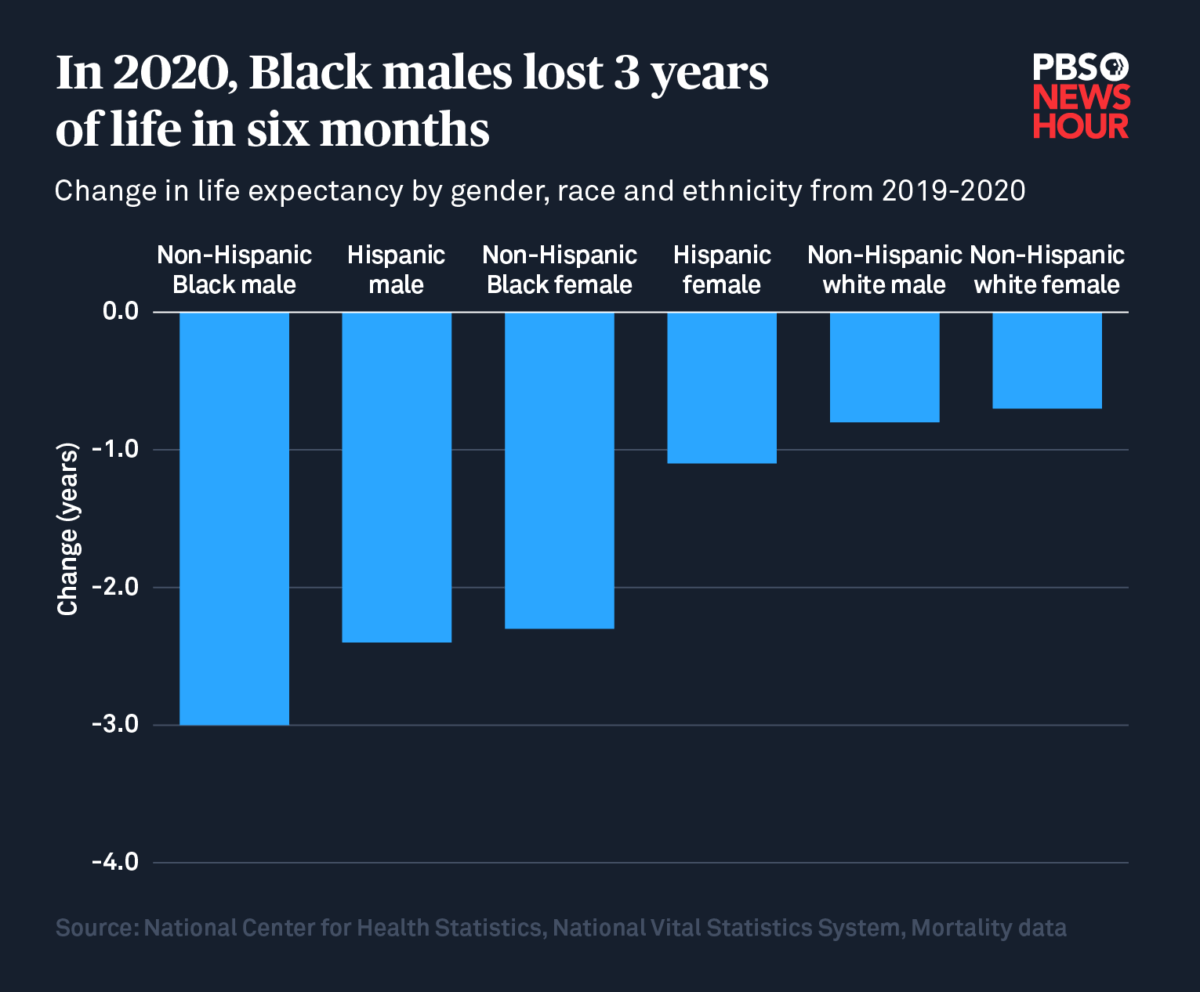
The stakes are higher in minority and low-income communities, where more adults are taking public transportation and working in front-line jobs, more live in crowded and multigenerational households, fewer have adequate health insurance and access to doctors and hospitals. Parents have seen family, friends and neighbors, including children, become sick, hospitalized, die. And they have less access to vaccines, with a huge racial disparity in vaccine distribution. Life expectancy dropped dramatically in the first six months of 2020, but the impact was greatest on people of color. While life expectancy dropped almost one year for whites, male and female, it dropped 3 years for Black males.
These parents may be right to distrust expert claims that children are not at great risk of infection. It’s not clear how many children get infected, since infected children may experience mild or no symptoms, and surveillance testing of school children without symptoms is rare. Award-winning New York Times science writer Apoorva Mandavilli tweeted, “We can only know what in-school transmission is if schools do regular testing — not just diagnostic testing of symptomatic people, but screening for asymptomatic ones, or surveillance of the school population as a whole.” Infected children can spread the virus to their households. For families with older or more susceptible household members, school reopening can be frightening.
The choice to keep the children home also brings up the racism and unequal education they encounter in school — tracking from preschool, subpar learning with too few teachers in overcrowded classes, substandard or missing facilities, unequal discipline in the “school to prison pipeline.” Many parents feel they are protecting their children from more than one kind of virus by keeping them home. “For generations, these public schools have failed us and prepared us for prison, and now it’s like they’re preparing us to pass away,” said Sarah Carpenter of Memphis Lift, where parents organize parents for quality education. “We know that our kids have lost a lot, but we’d rather our kids to be out of school than dead,” she said, in an interview for a Times article on Black families’ mistrust of school districts, government, and scientists.
“For generations, these public schools have failed us and prepared us for prison, and now it’s like they’re preparing us to pass away.”
Teachers and staff know better than to trust their school boards and mayors to keep them safe. But they can thank the parents for keeping their children home — the smaller classes which result allow for more physical distancing, protecting staff and children.
Whose viewpoint should we take?
What does the crisis look like if you take the viewpoint not of the Biden administration, or the CDC, or the politicians and school boards, or the Chambers of Commerce, or of the mostly white and middle class parents in the selective city schools and the affluent suburban schools? What does it look like if you take the viewpoint of the people excluded from those networks of power and privilege?
Then the issue is not just safety of the children, their families, school staff. We have to look at why the schools and cities were unable to quickly meet the safety requirements for reopening. More fundamentally, we have to see the impoverishment and maldistribution that has left Black, brown and lower income communities without the resources for health and safety that privileged families take for granted.
The American Rescue Plan Act is sending $122.8 billion to the schools. This should be an opportunity to think big about how to make them safe. Here are teachers, in the Chicago Teachers Union, asking us to think big about how one city’s $2 billion can be used, and their list gives you an idea of the profound deficits in city schools: “And remember,” the union says, “CPS is annually $2 billion short of adequacy. So what people are asking for in extraordinary circumstances is what our school communities are supposed to have every year.”
Add this to their list: Hire more teachers and build more space so city kids can have the small class sizes of the best private and suburban schools. Real safety requires small class sizes, and so does quality education.
The Rescue Plan should be just the first infusion for a rethinking of public education. The pandemic should be an opportunity to address everything needed to bring up our children, both in the schools and in their communities. That would be what we could expect in a humane and rational society.
Oh …
—Paul Elitzik
Thanks to Reilly Branson, award-winning comic artist and illustrator for the illustration. Reilly won best college cartoonist in three major student journalism competitions last year. He is open to commissions for illustration, caricature, comics, portraits of you or your house. See his work at reillybranson.com, Instagram: @rad_reilly. OK to reuse this blog’s illustration with his permission.
* Levels of community transmission defined as total new cases per 100,000 persons in the past 7 days (low, 0-9; moderate, 10-49; substantial, 50-99; high, ≥100) and percentage of positive tests in the past 7 days (low, <5%; moderate, 5-7.9%; substantial, 8-9.9%; high, ≥10%).” CDC’s Operational Strategy for K-12 Schools through Phased Mitigation, Updated Feb. 17, 2021.
**Nationally, 41% of parents want remote learning, 21% hybrid, and 35% fully in-person instruction, according to the USC’s Understanding America Study, an internet panel survey with 9,000 respondents.
31.1% of K-12 students are virtual only, 42.6% are in-person, every day, and 26.3% are attending hybrid schools, according to Burbio’s school opening tracker, as of Feb. 22, 2021.


